Thursday, May 16, 2013

Looking Back At Our School Year

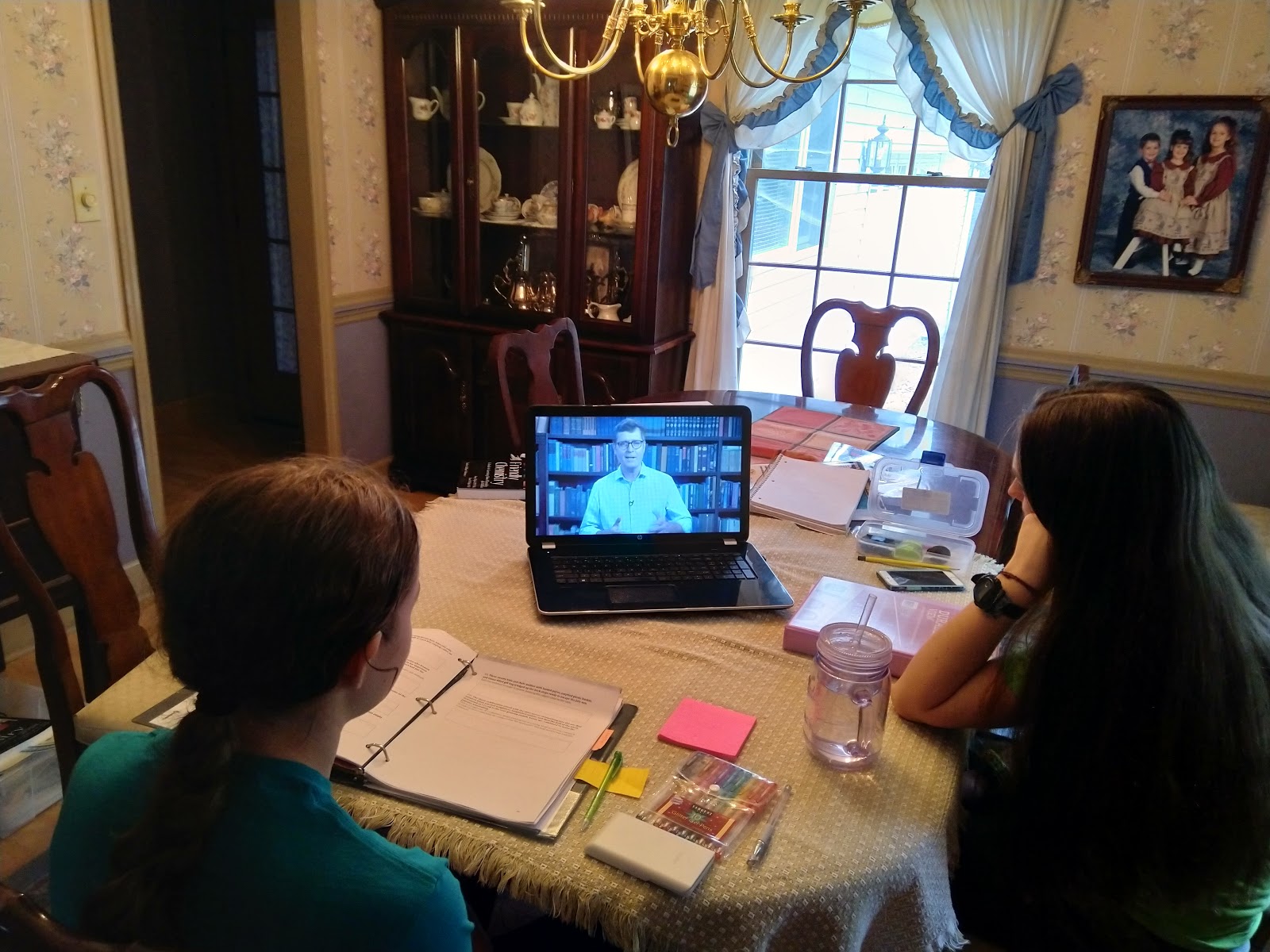
P1030097

Our school year is now drawing to a close. As we finish up the last week or two of our schedule, I’m starting to evaluate our school year and to think about what worked for us and what didn’t.

Curriculum: I’ve been pretty happy with our curriculum choices.  Our core curricula were No Nonsense Algebra, Math Essentials Geometry, Apologia General Science, Essentials in Writing, Lightning Literature and a literature-based World History study that I put together with the help of Sonlight books and Diana Waring’s curriculum. We had many other short-term and review items shuffled into the mix. This made for a busy year, but we enjoy trying new things and changing things up to keep school interesting.

Schedule: We started our school year in July with a light schedule. There were several reasons for our choice to school year-round. First, the Schoolhouse Crew moved to a year-round schedule, so I knew we would have review products over the summer. Second, I wanted to be able to take breaks throughout the year and to “get ahead,” so that we wouldn’t be quite so busy through the rest of the year.

Emily was happy enough with this plan, and it started out well. We took a 3 week vacation in November, then Emily went on a cruise with my parents and one of her cousins. She did take some schoolwork on our vacation, but I didn’t feel pressured for her to do a lot because of the extra time she had put in over the summer.

However, by the spring semester, I felt that I was really pushing her to get a lot done. She was balking at doing her work and was getting distracted. As we got further behind the schedule, I pushed harder, and she ended up losing her spring break and any other potential for time off because she wasn’t working enough on regular school days. This really destroyed the relaxed and pleasant atmosphere that I want in our home school, and I’m not sure either of us is finishing the year with a good feeling about it.

Now I’m evaluating what I need to do differently for next year. I need to be more relaxed and maybe not try to squeeze as much in. Emily needs to be more disciplined and responsible. She’ll be in eighth grade next year and I’m feeling the pressure to have her ready for high school work in just a year.

Travel: We really enjoyed our trip to Florida last fall. Part visiting with friends, and part field trip. Emily may go to public school in a year, so I would like to get in a few short trips or maybe a big one in the next year while we still have the freedom to travel in the fall, winter, or spring.

What worked or didn’t work for you this year?

Photobucket

Tuesday, May 14, 2013

High School Prep Genius (Schoolhouse Review)

 photo Untitled-1_zpsac2e8af4.jpg
Are you nervous about preparing your son or daughter for high school or college? Wondering how to prepare for those admissions tests, or which classes or activities he or she should have on a transcript? How to help your child learn better study skills or make decisions about his or her future path in life?  High School Prep Genius  ($29.95) covers all of this and more.
 
High School Prep Genius is a hefty 440 page book published by College Prep Genius, and written for middle school and high school students. The book itself is written to the student, but each chapter has a parent section as well.  There are three sections:
  1. Foundation For Personal Success: This section helps the student to think about his or her interests, beliefs, and values. It also offers valuable advice on improving relationships and managing finances.  Many of the chapters include  questions for the student to answer.
  2. Foundation for Academic Success: This section focuses on helping the young person become a better student, from discussing the value of obtaining a good education to teaching effective study strategies to test taking strategies to organization.
  3. Foundation for Future Success: This final section is most appropriate for older high school students and focuses on choosing a college, preparing for admissions tests, college applications, paying for college, and adjusting to life away from home.

The lengthy introduction to High School Prep Genius includes helpful charts and forms for keeping track of summer activities, scholarships, college applications, and to-do checklists for each year of middle school and high school.

I am very impressed with this book. I think it is an excellent guide for any student who wants to take high school work seriously and reach his or her potential, especially for those who plan to attend college.  Emily is just now finishing the 7th grade and I think this is a perfect time for her to begin reading this book and applying the principles. She has enjoyed the early sections on personal development as she thinks about making good choices in the areas of personal responsibility, financial management, and relationships with others. As she nears high school age, I think the tips on study skills will be invaluable.

Emily reports that she is finding the book interesting to read. She especially likes the questions at the ends of the chapters because they help her understand herself better and to apply the topics.

 High School Prep Genius is a book that we will keep on our shelf and pull out to use frequently throughout the next few years. It is packed with useful information and good helps for success in high school and for college preparation.

 
Photobucket

I received a free copy of this product in exchange for my honest review.

Friday, May 10, 2013

Raspberry Cheesecake in a Jar (Mother’s Day Dinner Blog Hop)

Some of my blogger friends and I are working together to present an online progressive dinner with some of our favorite recipes. This is my dessert contribution. Enjoy!

P1030071Raspberry Cheesecake in a Jar

Cheesecake Batter:

  • 2 8 oz. packages cream cheese
  • 1/2 cup sugar
  • 1 t. lemon juice
  • 2 eggs

Filling:

  • 1/2 cup raspberry jam
  • 1/2 cup raspberries (I used blueberries and raspberries.)

Crust:

  • 8 graham crackers, crushed

1. Beat the cream cheese and sugar until smooth. Beat in eggs and lemon juice.

2. Divide crushed graham crackers between 6-8 8 oz jars. Layer cream cheese mixture with jam and berries.

3. Place jars in a baking pan of water. Bake at 325 for 30 minutes or until set.

4. Top with additional berries.

Be sure to visit each of the bloggers below for your next course!

Thursday, May 9, 2013

Katie’s Senior Recital

My daughter, Katie, will be graduating next week from Birmingham Southern College with a Bachelor of Music in Music Composition. She had her senior recital Sunday showcasing a number of pieces that she had composed, some performed by her and some performed by others. I am so proud of my girl!

Here are a couple of her pieces….

.

Wednesday, May 8, 2013

H is for Hair!

We had quite a dramatic hair incident at our home 2 weeks ago. Emily was down the street playing with a friend when this friend’s young cousin snipped off half of her ponytail with a pair of scissors!!! Once all the trimming was done,  she ended up with a very short summer hair cut! After the initial trauma, she’s happy with the new cut. Me…not so much. It will take me a while to get used to.

Before….

P1020975

After…

P1030011

Blogging Through the Alphabet

Spanish for You (Schoolhouse Review)

PictureSpanish for You! is a Spanish curriculum that aims to be “simple, effective, and affordable.” It is designed for grades 3-8 and has several very unique features.

  1. Spanish for You! can be used with multiple grade levels. Separate lesson plans and worksheet are available for grades 3-4, 5-6, and 7-8. All students use the same text book, but the lesson plans beef up the program for older children.
  2. The program can be used with students of varying Spanish ability levels at the same time.
  3. The various units can be used in any order, according to interest.

The program includes these components:

  1. Softcover book or e-book
  2. Audio download of the entire book
  3. 24-30 week lesson plan guides
  4. nearly 200 worksheets with answers
  5. pictures for making flashcards

Two themed packages are currently available: Fiestas and Estaciones. A third unit, Viajes, will be available in June. We received the Estaciones (Seasons) package to review.

How the Program Works:

We used the lesson plans for 7-8th graders. Each day, several activities were assigned that included:

  • listening to audio from the audio files
  • making and drilling flashcards for the lesson vocabulary
  • doing a worksheet
  • playing a game to practice vocabulary
  • spelling words using Spanish letters
  • asking and answering questions using the lesson phrases and vocabulary
  • writing a short story using specified vocabulary

I thought that the activities were varied and interesting. The lesson plans were a tiny bit awkward to use, involving flipping around in the lesson book to locating files on the computer, etc. It would have been easier to have the plans directly in the lesson book. However, the plans are designed as they are  because the plans are different for different age groups.

I especially like that verb conjugation is taught starting with the first lesson. So many Spanish programs for children just teach words and phrases, but don’t teach conjugation. I feel like Emily is not just learning vocabulary and phrases, but she is learning the tools she needs to use the language.

P1030041

Playing “Burbujas” (Bubbles)—One player blows bubbles and calls out a verb. The second player has to fully conjugate the verb before all the bubbles pop.

P1030067

Playing “Que Falta?” (What’s missing?)

We typically spent about 20 minutes a day doing the assigned activities. Some days, Emily worked on her own, and some days, I supervised her, played practice games with her or had her read the lesson aloud to me.

When I first looked at Spanish for You!, I was afraid that it would be very teacher intensive, with lots of games and activities that I’d have to plan. That turned out not to be the case. Although there are some games, and certainly some degree of interaction is needed when studying a foreign language, once we got started, Emily was able to look at the lesson plans herself and do most of the assignments on her own. Certainly, that would not be the case for a much younger child, but I only had to spend about 5 minutes a day with my middle schooler checking a worksheet, asking her a few questions in Spanish, or quizzing her on vocabulary.

Cost:

  • $39.95  Grade level package (3-4, 5-6, or 7-8)
  • $64.95  Package including lesson plans for all grades


Photobucket

I recieved a free copy of this product in exchange for my honest review.

Tuesday, May 7, 2013

Frugal Homeschooling

I’ve always been very frugal—shopping sales, couponing, cooking from scratch, and so on. In the past several years, my financial situation has been such that I HAD to save money where I could because there just hasn’t been money for “extras.” And of course, this philosophy extends to homeschooling!

To look at the cost of many homeschool curriculum packages, especially when considering buying for several children, one might think that homeschooling had to be prohibitively expensive. Now some curriculum packages are great! They simplify planning and give parents a solid framework to work with. But for those who can’t afford them, or who just choose to go a different route, there are many less expensive options. Here are some of the ways we have homeschooled inexpensively:

  • Use the library. If I had to, I could use library resources exclusively for reading instruction, science, and history/social studies. Even when using another curriculum, supplementing with library books can be a valuable addition.  Many libraries even have foreign language programs that are available for check-out or accessible online.
  • Buy partial curricula. We used (and loved) Sonlight Curriculum for several years. I bought the teacher’s guides and the books that our library didn’t have (or that we didn’t already own). I would have loved the thrill of opening a box packed full of Sonlight books, but couldn’t rationalize the expense. Sonlight makes is a little harder to do this now, and their manuals are more expensive than they used to be, but this is still a way to use a particular curriculum and save some money.
  • Scholastic books—As a homeschooler, you can sign up for a school account and get great deals on scholastic book orders. Most months, they offer $10-$20 worth of free books with a $20 order as well as bonus points that are redeemable for more books.
  • Shop for used curricula (ebay, homeschoolclassifieds.com) or discounted curricula (Rainbow Resource, Timberdoodle).
  • Re-use! Much of what Emily is using now was purchased for my older children.
  • Use online resources. Schoolhouse Teachers is a great resource for only  $12.95 a month ($3 for the first month); Educational game sites like ZooWhiz or Always Ice Cream/Clever Dragons are inexpensive or even free for limited accounts.
  • Schoolhouse Review Crew—Through my reviewing with the Schoolhouse Crew, I’ve had to spend very little for school in the past few years and have tried lots of books and programs that may have been out of my budget otherwise. It’s a lot of work, but has been a great blessing to me!

My older children attended public high school which, in our area at least, is anything but free! Many of the upper level (“not required”) classes such as AP sciences had $20-$40 fees. Theater and dance programs had $200 fees plus fund-raising (yuck!).  Cheaper than outside lessons, but still pricey. Then, there’s the gas expense of driving kids to school each day (no bus service here). I know I spend less on homeschooling than I paid for public school!

Monday, May 6, 2013

Papa’s Pearls (Schoolhouse Review)

 photo papaspearls_zps509cd1df.jpg

Papa’s Pearls, by Diane Flynn Keith, is a sweet book that tells about the life of the author’s father and about the profound effect that “Papa”  had on his family. The author tells stories about the life of Carol Joseph Flynn,  from his beginnings as a delinquent youth, headed for a life of trouble, to his transformation to a loving father, responsible citizen, and successful businessman.

These often humorous anecdotes begin with “Papa’s” childhood as he was growing up in San Francisco in the 1920’s and 1930’s. I loved these “snapshots” of life in a simpler, yet in some ways, much more difficult time. Although, it is not the primary intent of the book, there is a lot of history here. Something about the story reminded me of one of my favorite books, Cheaper By the Dozen, also a story written about a father by his daughter.

Each chapter focuses on a few of “Papa’s pearls” of practical advice, loving actions, and life-success principles.  Here are a few:

  • “Bad things just don’t happen to our family”  was an expression of Papa’s positive attitude. Even in the worst of times, he looked for the good and put a positive spin on the situation.
  • “Tell yourself you like it” was his mantra for the most unpleasant jobs that had to be done. He told his children that, with the right attitude, anything was tolerable, or even pleasant.
  • “I love you. You know that, right?” was told to his children and grandchildren over and over again. No one ever doubted that he or she was thoroughly loved.
  • “Be grateful every day.” Remember how blessed you are.

I really enjoyed reading this book. It left me with a warm, cozy feeling. Papa’s love and nurture of his family was evident. Many of the principles he taught were probably just common sense to previous generations, imparting the values of hard work, responsibility, and respect for others, but they are values that our children may not see valued in our current society.

I was inspired to incorporate some of Papa’s practices and sayings into my own family. From letting go of grudges, to keeping a positive attitude, to making sure that my family knows that I love them always, I hope that I will be changed and not just entertained by Papa’s Pearls.

Here is what Emily (age 12) had to say after reading Papa’s Pearls:

My favorite saying in Papa's Pearls is a moral and a lesson that I think everybody should listen to.

“ When You Fall Down-

Get Back Up, Brush Yourself Off and Try Again!”

That saying has a lot of meaning! It encourages us to keep our pride and not to give up. That saying means a lot to me and probably others if they stop and think about it. How many times have people tried something new and failed at it? How many people love doing something but they just can’t get a good grip on it?

This saying means a lot to the people that stop and think about how many times it has happened to them. Don't give up just because something small and tiny brings you down! You have to stay strong and practice at it until you get better at it! I never really stopped to think about this before, but what if we just gave up on our dreams? What if we gave up right after the first try? Where would we be? Where would the world be? If we didn’t try something that we love doing, then who knows where we would be. Think about singers or dancers; they finally found something that they’re good at and they stuck with it until they got better! If those singers or those dancers had given up right after they had fallen or hit a wrong note, then we wouldn’t be getting entertainment! We wouldn’t be listening to music when we do our chores or when we turn on the TV because they gave up after the first try!

Go after your dreams, who knows, after you keep on trying at that one thing you love, you could change the world. If you just try, just like those singers and dancers have, you could provide entertainment for millions of people to watch or listen to.

Papa’s Pearls is available for $14.97 + shipping  and is an enjoyable and motivational book that is appropriate for pre-teens to adults.

Photobucket

I received this product free in exchange for my honest review.

Thursday, May 2, 2013

G is for Graffiti

Blogging Through the Alphabet

My daughter, Allison, wrote this a few years ago when she was a student at Samford University.  It made me laugh and I thought others might enjoy it too.

Give Up on the Graffiti

"Don't cheat" proclaim the words that are staring at me from the back panel of the cubicle in which I am sitting. Thank you, Mr. (or Ms.) Library Graffiti Artist. I'm glad you're such an upstanding moral citizen.


As I diligently procrastinate studying for the midterm I have tomorrow, I can't help thinking to myself that while there is probably graffiti in every college campus's library, there is one type that is probably unique to Samford. What is it, you ask?
It's not the different Greek letters. Although, I have to admit, those do kind of puzzle me. I mean, what exactly is the point? Is it a recruitment thing? Or is it some secret sorority/fraternity contest that leaves independents in the dark?
I can just imagine the announcements at chapter meetings: "In a disturbing twist to this week's race, there are now more than 30 Sigma Chi logos carved on those cubicles. We've got to step it up, boys."


It's not the "Annie loves Joe" inscriptions, either. I'm sure library tables on every campus have these. Why, though?
Is it a poor college student's version of a matchmaking service? "Maybe if Joe sits at this same table sometime during the next four years, he'll know I have feelings for him!"
Or maybe by that time, you'll have found a different boyfriend, and you'll have to make sure neither of them ever comes near the table where that freshman year Connections group crush is now on permanent display for the next 30 years.


While pretty much all forms of graffiti are a mystery to me, that Samford specialty of the Bible verses are perhaps the most intriguing. Because I brought some BP homework with me to the library, I conveniently have my New Interpreter's Study Bible handy, so I look some of them up. To save you the trouble, I've reproduced them, along with my own interpretation of what the graffiti-ist might have meant.


On a second-floor round table: 1 Peter 1:8-9, "Although you have not seen him, you love him; and even though you do not see him now, you believe in him and rejoice with an indescribable and glorious joy, for you are receiving the outcome of your faith, the salvation of your souls." 
I guess I haven't felt the type of "indescribable and glorious joy" that makes you really want to dig into something with a pencil.


In a third-floor cubicle: Jeremiah 33:3, "Call to me and I will answer you, and will tell you great and hidden things that you have not known."
Sounds great. Could you leave your phone number next time? And are these "great and hidden things" in any way related to that midterm I have tomorrow?


In the same cubicle: 1 Peter 5:7, "Cast all your anxiety on him, because he cares for you."  I'm glad you have no anxiety. Really, I am. But the Library Police could be just around the corner. Aren't you just the tiniest bit afraid they might catch you with that Sharpie?


I know that Deuteronomy 6:9 says to write the Scriptures "on the doorposts of your house and on your gates." But Proverbs 3:3 says to "bind them around your neck, write them on the tablet of your heart."  Don't you think that's just a little more practical (and respectful of school property) than carving them into that table at the library?

Monday, April 29, 2013

Home School in the Woods Composer Study (Schoolhouse Review)

 photo HSitW-NewLOGO-website_zps0d8de564.gif

Composers….one of those topics that I’ve always wanted to have Emily study, but just never found the time to fit it in!  I recently remedied that by embarking on a study of composers from the Middle Ages to modern times with the help of  Home School in the Woods’ Hands-On Activity Pak on Composers.

P1020992

This lap-book study includes 6 different projects covering 42 composers, the orchestra, and musical terminology. Some of the activities included making a timeline of composers, a lift-the-flap keyboard to learn musical terms, such as sonata,  minuet, pitch, orchestration, measure, etc., and making a small booklet about each composer.

P1020983

P1020982

We studied a new composer every day or two, making this a quick survey of composers, but after over a month of using the Activity Pak, we still are barely into the Romantic Period and have many more to composers to cover! 

In order to learn about each composer and the different period of music, we had to do some outside research. The Composers Activity Pak includes matching cards with the composers’ pictures and very basic information, but we didn’t find that to be enough. We found several excellent children’s books about composers at the library. We also used the internet and other resources we had at hand.

One feature that we especially liked were the 29 included recordings (over 90 minutes of music). This made it so easy to read about a composer, then pick a selection from that composer to listen to while Emily wrote or drew about her impressions of the music on the corresponding Music Appreciation page.

P1020991

P1020990

My Thoughts:

  • I love the artwork in this Activity Pak. As with all Home School in the Woods products, the graphics are beautiful.
  • The resulting lap book is attractive and covers a variety of music topics, from composers to music terminology to instruments in an orchestra.
  • I loved the included music selections for many of the composers.
  • I wish there had been more actual teaching information included about the composers and periods of music so that this would have been more of a self-contained study.
  • Every single page was in a separate PDF file. This made it very tedious and time-consuming to print. If these pages had been combined into one or even several files, printing would have been so much easier!
  • Overall, this was a fun study that complemented our current world history studies.

The Hands-On History Composers Activity-Pak sells for:

  • $18.95 (download)
  • $19.95 (cd)

Other members of the Schoolhouse Review Crew reviewed other products from Home School in the Woods. Click on the banner below to read more!

Photobucket

disclaimer_thumb6_thumb_thumb

Thursday, April 25, 2013

Teach Your Child the /f/ and /v/ Sounds


F

Does your child have trouble pronouncing the /f/ or /v/ sound? The most common error for /f/ is substituting the /p/ sound for it (“pish” for “fish”).  A common error for /v/ is a /b/ substitution (“ban” for “van”).  /F/ should be mastered by the time a child is four years old. /V/ develops a little later and is often not mastered until age 5 or 6. Because they are very similar sounds, though, they are often taught together.

Here is an excerpt from my book, Super Star Speech, to use with your child.

F and V

F and V are produced by touching the upper teeth to the lower lip. F is produced by passing the breath between the teeth and lip. V is produced in the same way with the voice “turned on.”

Tips:

1. /f/ and /v/ are easy sounds to teach because the placement is so easy to see. Instruct the child to “bite his lip and blow” to produce /f/. After the /f/ is produced, instruct him to “turn his voice on” to produce the /v/. Use of a mirror may be helpful.

2. Work on auditory discrimination between the error sound and /f/ and /v/. (“Is this a pig or a fig?”)

3. If /v/ is not being vocalized, thereby sounding like an /f/, have the child feel the vibrations on his neck while saying the sound. Produce /v/ with a vowel (“Va, Vee, uh-V”).

I have some practice pages for the F and V sounds (and other speech tips) posted on my Super Star Speech Resource Page.

I’m Blogging Through the Alphabet with Ben and Me.